Same Sky, Different Ground

The reef-to-range gradient · an explorer

Read the country

Six worlds, one short slope. Travel the Sunshine Coast from the reef to the range and, at each stop, see not just what is growing there but why — the chain that runs from the rock, through the soil and the water and the fire, to the living thing in front of you. Learn to read that chain once, and you can read almost any patch of ground you stand on.

The whole trick, on a napkin

Geology writes the rules, soils translate them, living things live them out — and people change them. The same rain falls on most of this slope. What changes, top to bottom, is the ground itself.

So don't start with the leaf. Start with the rock and the soil and the water, and the plants fall into place. That's the reading skill this explorer teaches, one stop at a time.

Reef Estuary Wallum Swamp Eucalypt Rainforest
Stop 1 of 6

Stop 1 of 6 · Reef → range

The cue

Warm, clear water over a rocky headland — and hard coral growing a fin's length from a cool-water sponge.

Sea country & reef

The land's gradient doesn't stop at the beach. It runs on underwater, through seagrass meadows and sand flats to the headland reefs — the far, wet end of one continuous slope from the range to the reef.

Why it's here — the reading

Read it yourself — look for

  • Coral and sponge sharing a single boulder
  • Reef fish moving in steady pairs
  • Pipis and ghost crabs working the surf beach
  • A humpback's spout past the break, in winter
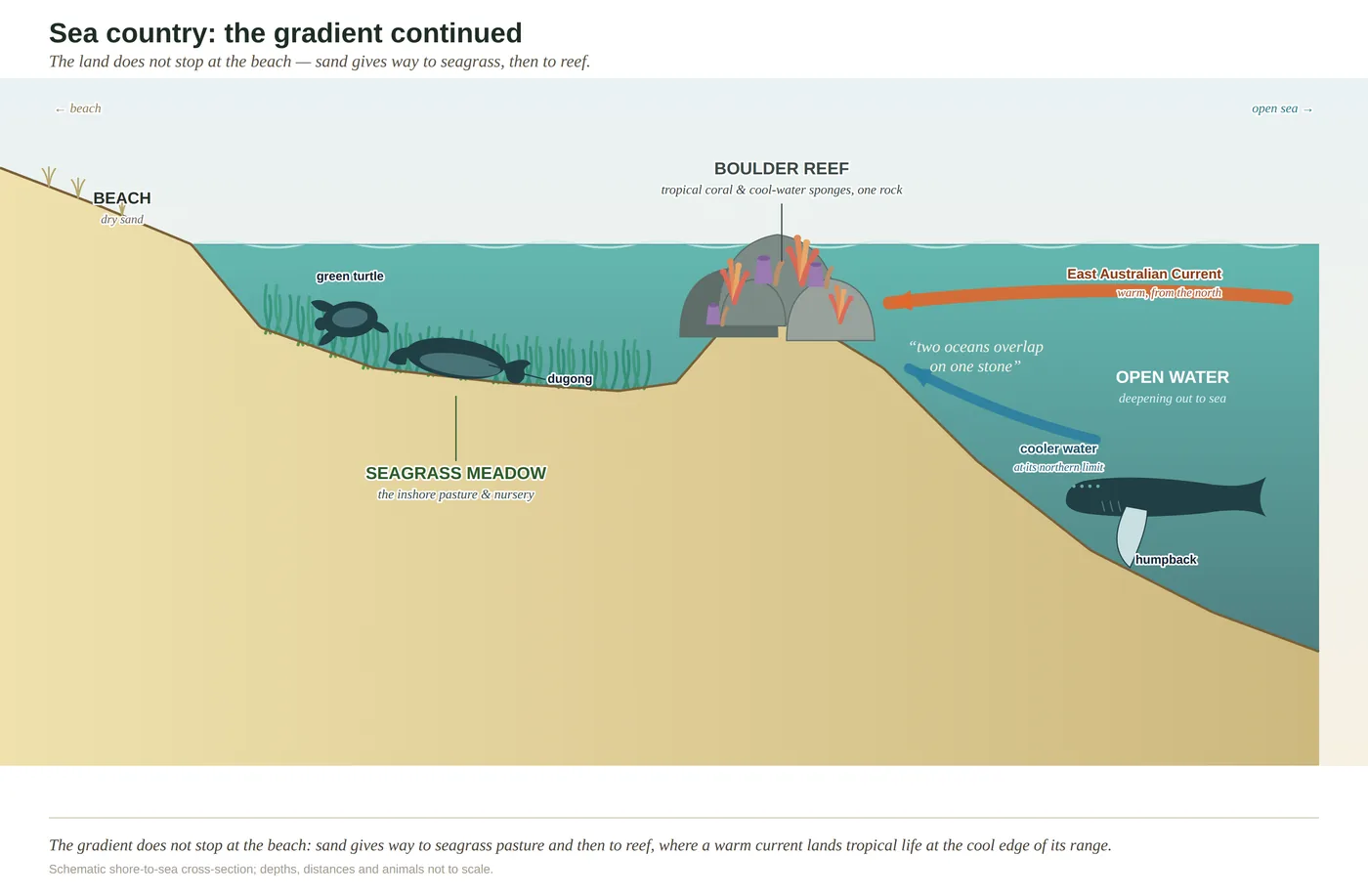
Diagram of Sunshine Coast sea country: seagrass and sand flats leading out to a headland reef where warm- and cool-water species overlap.
Sea country. The gradient carried underwater — seagrass and sand flats out to the reef, where a warm current lets tropical and cool-water life share the same headland.

Stop 2 of 6 · Reef → range

The cue

Black mud that smells of sulphur, studded with thousands of pencil-thin spikes — and a pale army of crabs sifting the flat.

Estuary, mangrove & saltmarsh

Where the rivers meet the tide, the land gives up the argument and dissolves into mangrove, saltmarsh and seagrass — the most productive ground of the lot, and the powerhouse of the coast's fisheries.

Why it's here — the reading

Read it yourself — look for

  • Pencil-thin breathing roots standing out of the ooze
  • A faint crust of salt on the leaves
  • Marble-sized soldier crabs sifting the flat at low tide
  • The tide breathing in and out, twice a day, forever
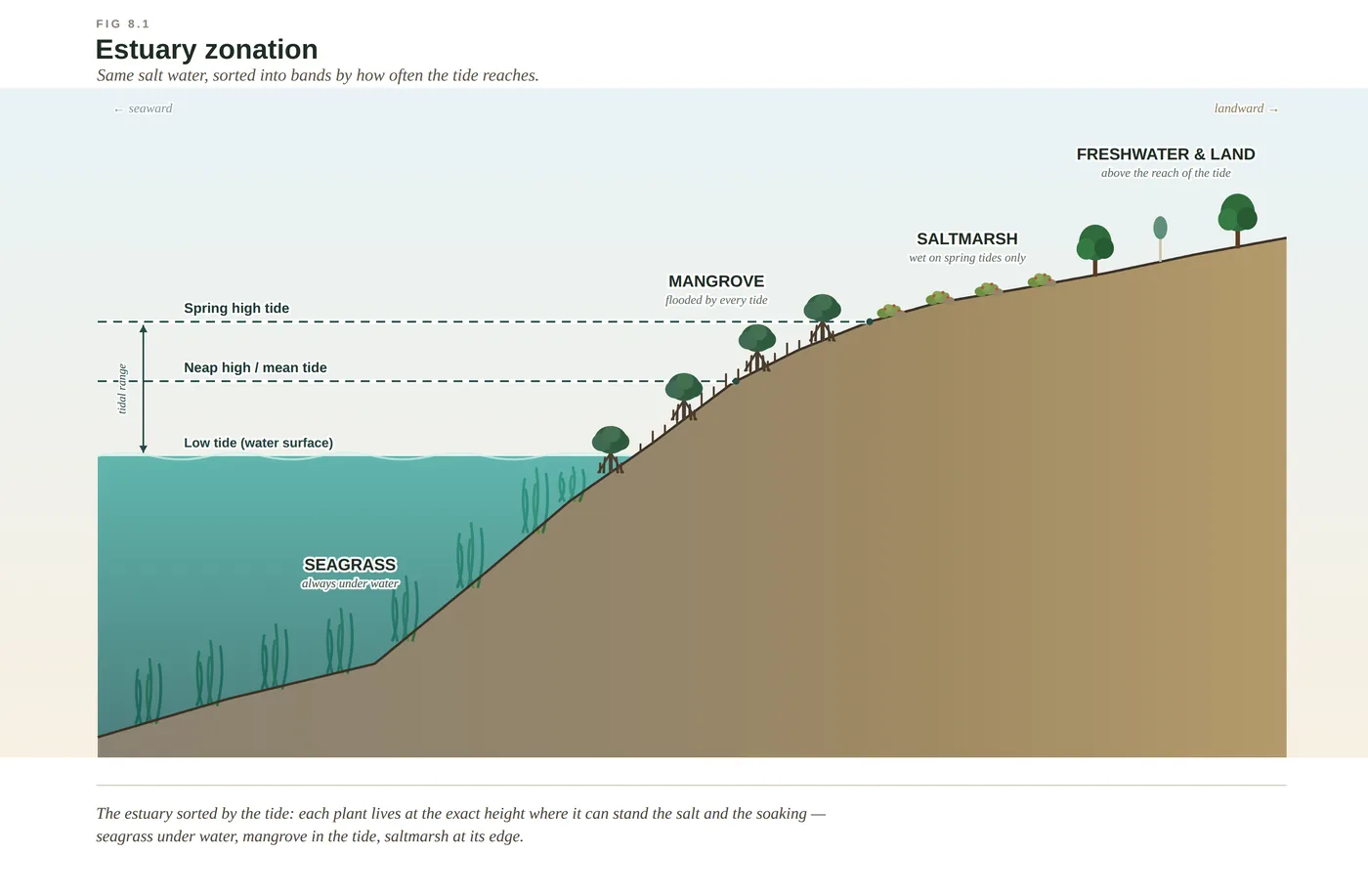
Diagram of estuary zonation, from seagrass and mangrove through saltmarsh to the brackish fringe, banded by how often the tide covers each zone.
Estuary zonation. Nothing is random here — each band, from mangrove to saltmarsh, is set by exactly how long the tide covers it each day.

Stop 3 of 6 · Reef → range

The cue

Bright, bleached, bottomless white sand — and scrub that looked like nothing, suddenly loud with spring flowers and honeyeaters.

Wallum heath & dunes

Heath and low woodland on bright, acid, hungry sand: the gradient's specialist quarter. It is the strangest lesson on the slope — the poorest ground of all, carrying the richest flora on the coast.

Why it's here — the reading

Read it yourself — look for

  • Bright white sand underfoot
  • A spring riot of hard-leaved wildflowers
  • Standing water the colour of strong, cold tea
  • Knobbly banksia cones, old ones gone grey
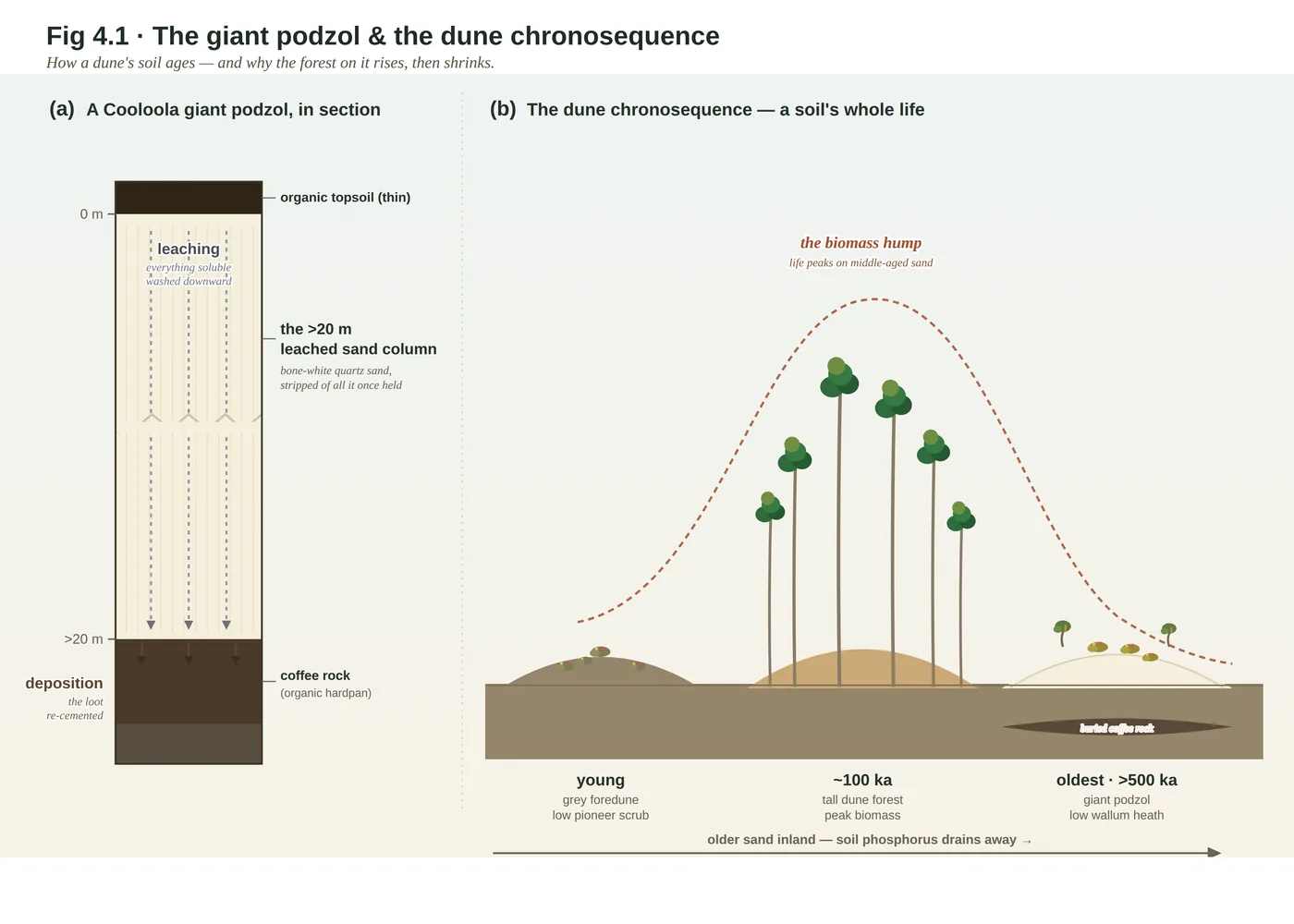
Diagram of a podzol soil profile on the Cooloola dunes, showing bleached white sand over a dark buried layer, with the vegetation shrinking as the sand ages and loses nutrients.
The paradox in the sand. As the dune sand ages it loses its last nutrients — and the forest shrinks to low heath. Sheer poverty is what breeds the crowd of species.

Stop 4 of 6 · Reef → range

The cue

Trees standing with their feet underwater, their pale bark peeling off in papery sheets you could lift by the handful.

Paperbark swamp & floodplain

In the floodplain's wettest hollows, broad-leaved paperbarks gather over still, tea-dark water. These wetlands look humble and are anything but: flood sponge, water filter and nursery, all at once and all on the one shift.

Why it's here — the reading

Read it yourself — look for

  • Bark you can lift off the trunk in papery handfuls
  • Creamy bottlebrush flowers dripping nectar
  • Wiry sedges crowding the water's edge
  • Still, dark, standing water between the trunks
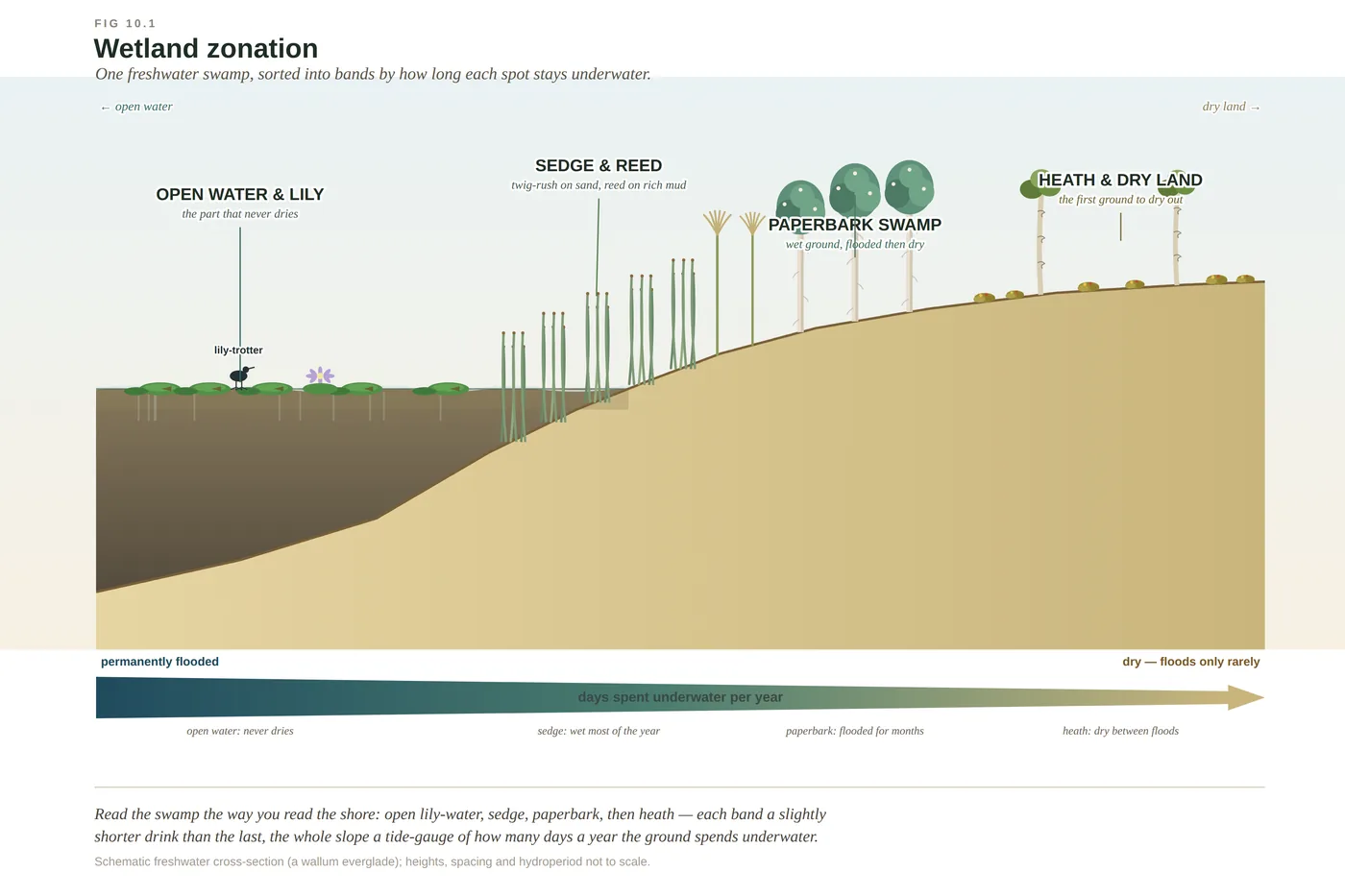
Diagram of freshwater wetland zonation, from open water through sedges to paperbark swamp forest, banded by how wet the ground stays.
Wetland zonation. From open water to paperbark forest, each band marks how long the ground stays wet — the same read-the-water logic as the estuary, in fresh water.

Stop 5 of 6 · Reef → range

The cue

A dry, open slope where you can see a long way between the trunks — one tree shedding to apricot bark, another armoured near-black.

Eucalypt forest & woodland

Open gum forest and woodland over a grassy, sunlit floor — the country nine people in ten picture the moment you say "the Australian bush." This is fire's own country, and it depends on the burn.

Why it's here — the reading

Read it yourself — look for

  • A grassy, sunlit floor you can see straight through
  • Smooth-shedding grey gum beside hard-armoured ironbark
  • A she-oak's soft, continuous sigh on the breeze
  • Scratch-marked koala feed trees
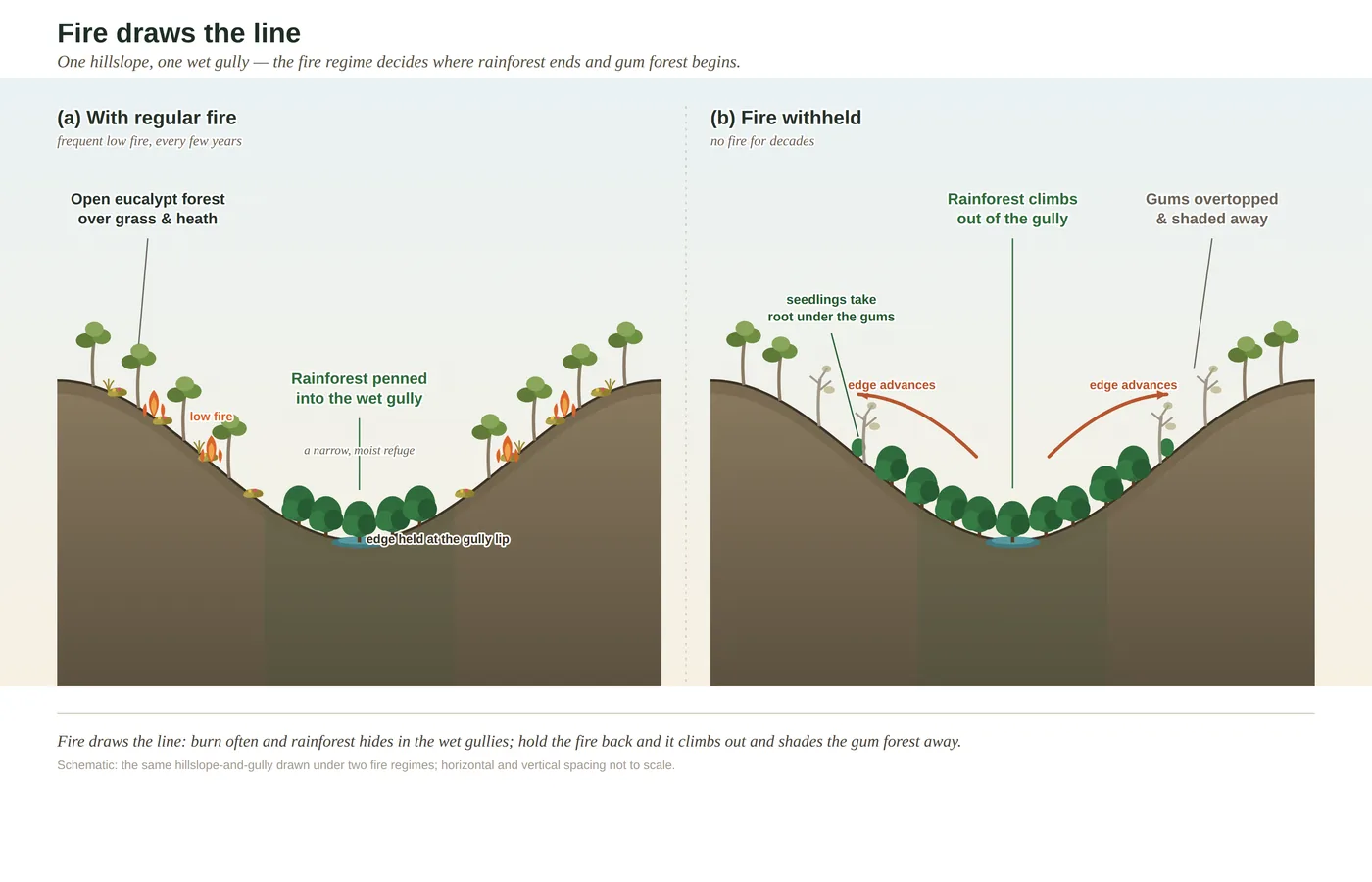
Diagram of a fire boundary where regularly burnt open eucalypt forest meets unburnt rainforest, showing fire holding the two forests apart.
Fire draws the line. Where the burning stops, the rainforest advances. Read a sharp forest edge and you are often reading a fire history.

Stop 6 of 6 · Journey's end

The cue

One pace off the mown grass and the light drops by half; the air turns cool and damp, and the soil underfoot is a deep chocolate red.

Rainforest — the range

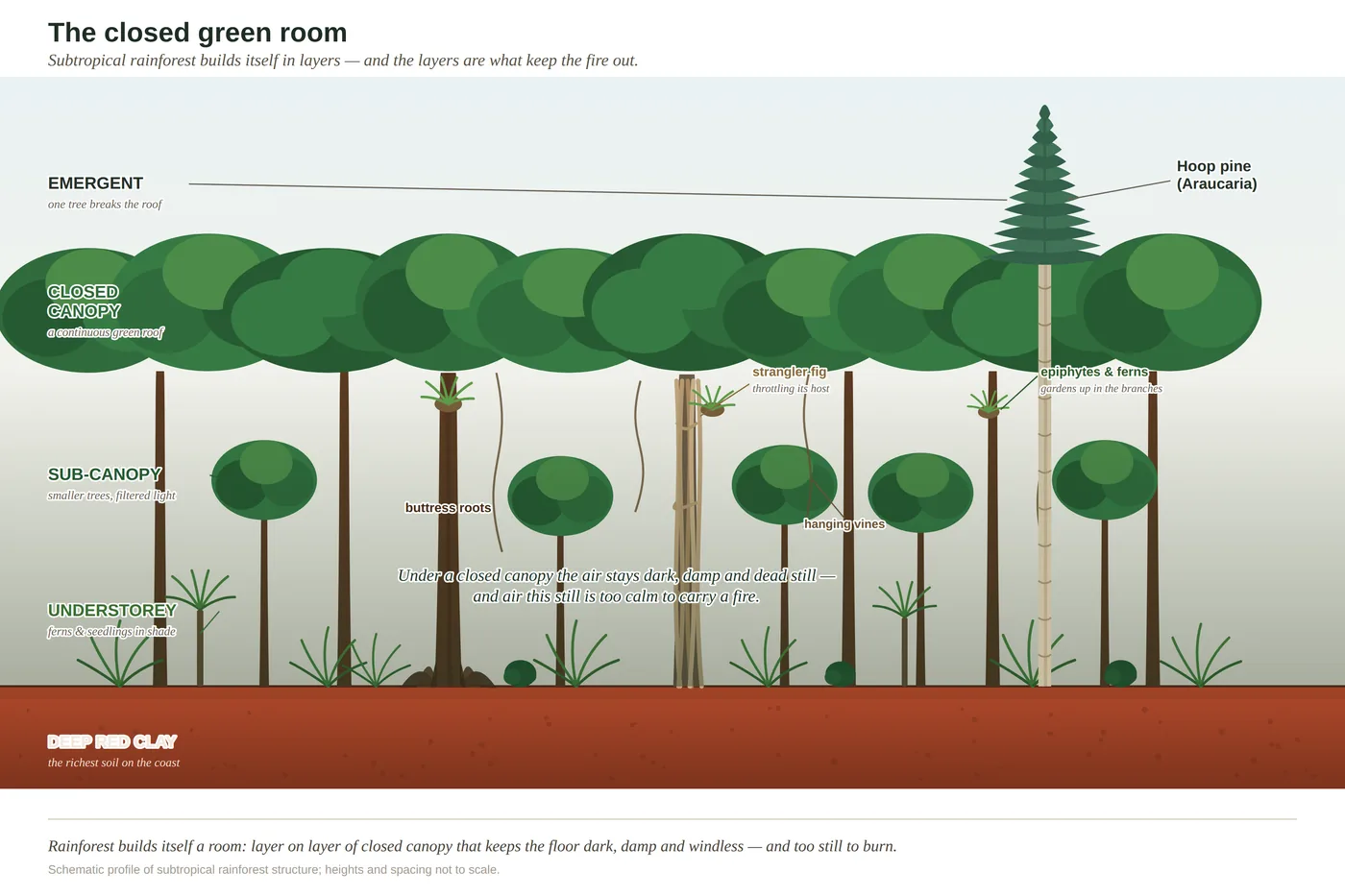
The "big scrub" on red basalt: the richest soil and the gentlest climate on the whole slope, and fire's exact opposite — a closed, humid world that keeps fire out by refusing to dry. We began in the richest water; we end in the richest earth.

Why it's here — the reading

Read it yourself — look for

  • The light dropping the instant you step in
  • Buttress roots, and a strangler fig at work
  • Chocolate-red soil underfoot
  • A whipbird's whip-crack out of the gloom
Diagram of a subtropical rainforest structure with buttressed trees, a hoop pine emerging above the canopy, palms and a dim, layered interior.
Rainforest. Rich basalt soil and reliable rain, spent on structure — buttressed giants, emergent hoop pines, a shaded, self-watering world that shuts fire out.
The same rain falls on most of this slope. What changes is the ground.

The pattern under everything

One rule, at every scale

The great slope from the range to the sea is only the grandest performance of the rule. The same read works on a single hillside — dry, open forest on the sunny slope; wet forest in the shady gully — on one ageing dune field, or on the two banks of a single creek, if one is basalt and the other sand.

Once you have it, you never quite look at a hillside the same way again. You see instead a set of answers to a single question the land is forever being asked — what will grow here, given this rock, this soil, this water — and you find you can very often read the answer before you have taken a step.

The full five-minute reading →

Now test yourself

Can you read the country?

You've walked the gradient. Now you're dropped somewhere on the coast with nothing but what you can see — the soil, the light, the water, the plants. Which country are you standing in?

Question 1 of 8Score 0

Take it further

Keep reading the country

This explorer is the whole idea in miniature. Two ways to carry it outside — one free, one for the price of a coffee.

Free · the seasonal dispatch

What's worth reading this month

Join the free dispatch and get on the app waitlist: a short seasonal note on what the coast is doing right now — what's in flower, what's on the move, and where to go and read it. No spam, unsubscribe any time.

Join the dispatch

The book · from 15 July

Same Sky, Different Ground

The whole gradient, in full — the reef, the range and every world between, told as warm, accurate natural history. Same Sky, Different Ground launches 15 July 2026 at A$9.99.

About the book