Same Sky, Different Ground

The ecosystems

Every kind of country, from reef to range

Six habitats, stacked up a single slope. For each one: how to know it on sight, why it sits where it does, who lives there, and where to go and see it for yourself.

Estuaries, mangroves & saltmarsh

The smelliest, most maligned ground on the coast is the one that feeds all the rest.

Recognise it
Muddy tidal flats where the rivers meet the sea, flooded and drained twice a day. Dark trees breathing through a thousand upright pencil-roots are mangrove; the grey-green succulent carpet baking above the tideline is saltmarsh; the green meadow in the clear shallows is seagrass. If it is mud you can smell before you see it, you are there.
Why it's here
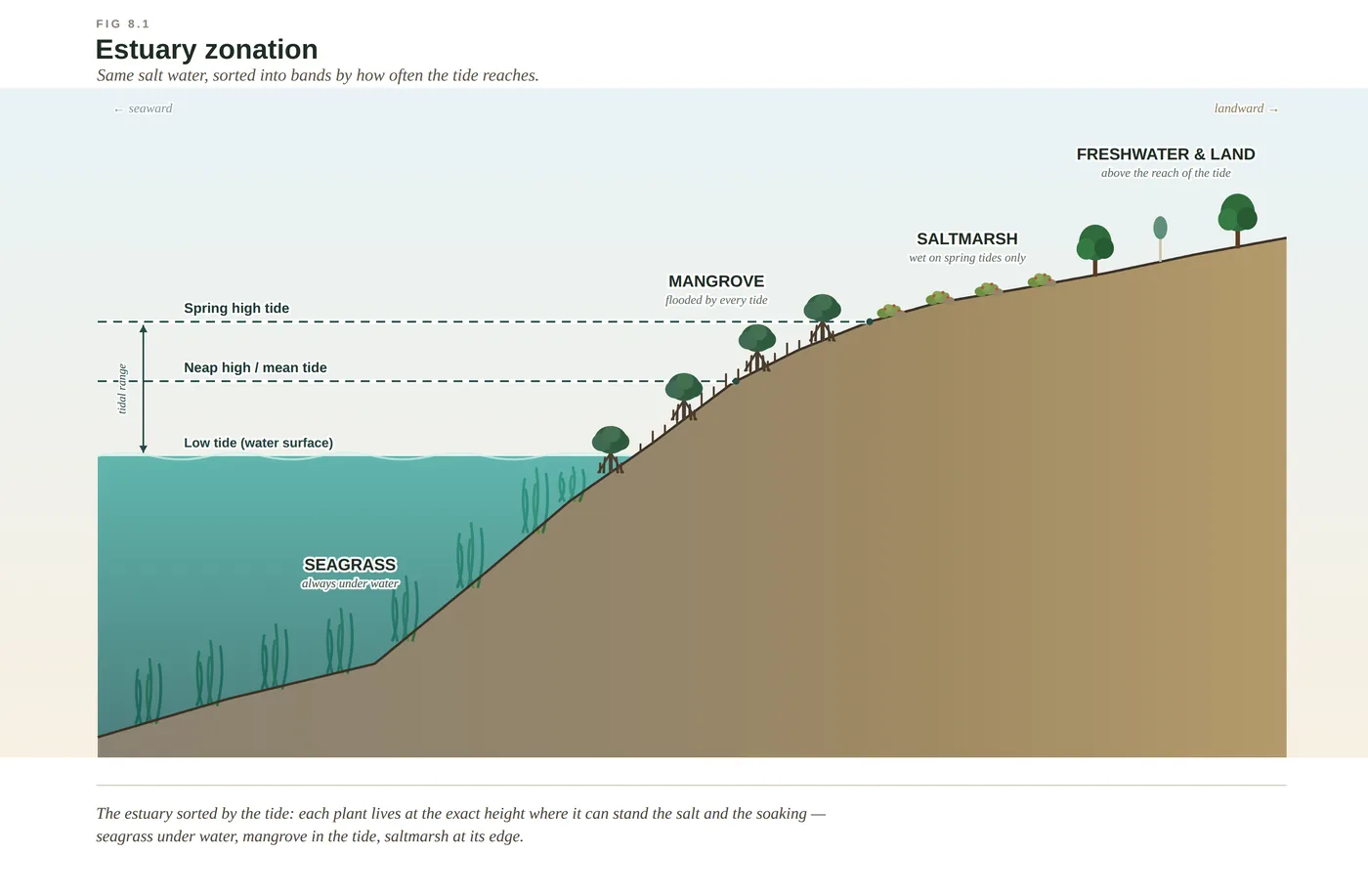
A single variable sorts the whole place into bands: how often the salt water reaches. Each plant lives at the tidal height where it can just stand the salt and the soaking, so the estuary is the great land gradient compressed into a few hundred metres and driven by the tide.
Who lives here
Grey mangroves sweat salt from their leaves; leaf-eating crabs shred the leaf-fall that feeds the prawns and fish; soldier crabs march the open mud in pale-blue armies. Migratory godwits refuel here after flying non-stop from the Arctic.
Where to see it
Walk the elevated boardwalk at the Maroochy Wetlands Sanctuary, Bli Bli, or paddle the sheltered Pumicestone Passage.
Estuary zonation cross-section
Estuary zonation: each plant lives at the tidal height it can bear.

Dunes, wallum & acid waters

The poorest country on the coast, and one of the richest gardens in Australia.

Recognise it
Behind the beach, a low, hard-leaved, grey-green heath on bottomless bleached white sand, unremarkable until spring, when it erupts into banksias, peas, wildflowers and insect-eating sundews. Threaded through it is standing water the colour of strong, cold tea.
Why it's here
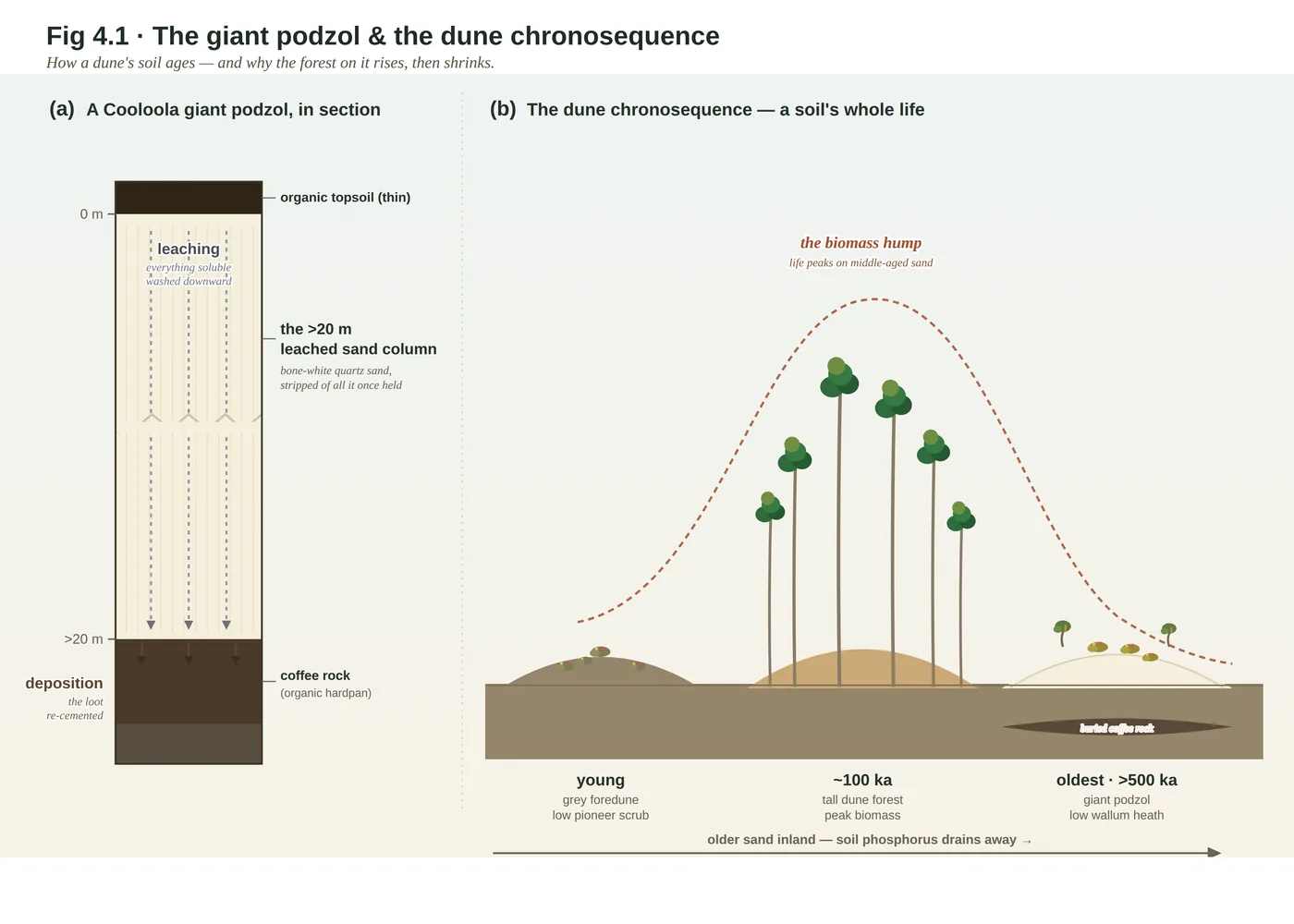
The sand is leached almost to pure poverty. That crushing scarcity stops any one plant from growing fast enough to dominate, so hundreds of specialists share the ground, each making a living a slightly different way. Fire, and a hidden water table, hold the whole thing together.
Who lives here
Wallum banksias hoard fire-sealed seed; sundews and bladderworts trap animals for nitrogen the sand won't give. In the acid, tea-dark water live the acid frogs, which have evolved to breed in water like vinegar precisely because it keeps their enemies out.
Where to see it
Follow a sandy track into the heath at Cooloola, in Great Sandy National Park.
Giant podzol and dune chronosequence
The giant podzol: bone-white sand stripped of everything soluble.

Paperbark swamps & freshwater wetlands

A machine that stores floods, filters water and banks carbon, quietly and for free.

Recognise it
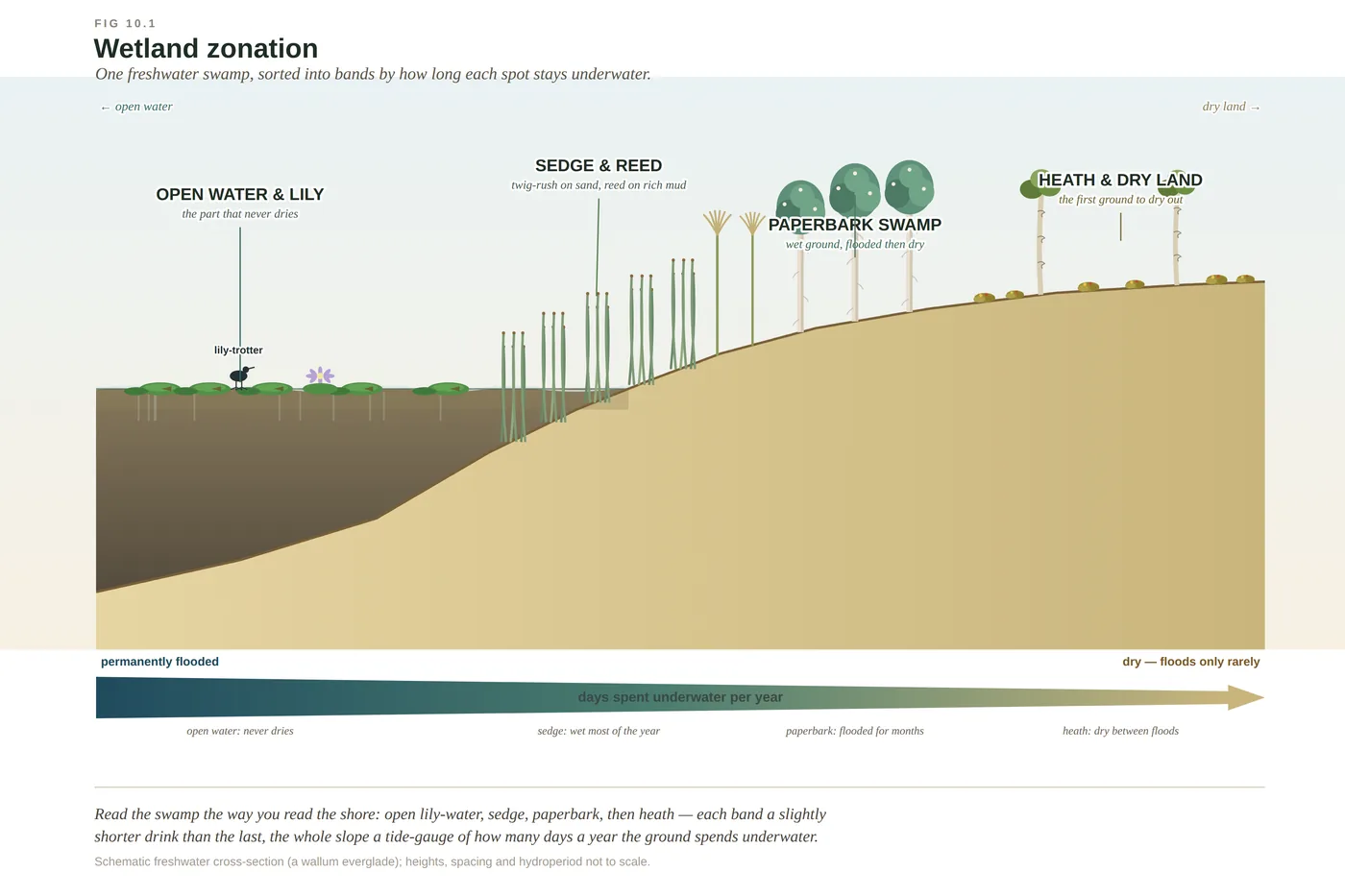
Dense stands of pale, papery-barked trees with their feet in the water, giving way to reedy or sedgy open water and tea-stained lagoons. Read the plant bands from open lily-water through sedge to paperbark and heath as a tide-gauge of how long each spot stays wet.
Why it's here
Here it all comes down to time spent underwater — how many days a year the ground stays flooded. Count those days and you have the plant bands. The rest is the work of the airless, waterlogged mud, which banks peat and carbon and keeps the buried acid safely asleep.
Who lives here
Broad-leaved paperbarks flower in a nectar flood that draws lorikeets and flying-foxes; frogs chorus after rain; egrets, ibis, spoonbills and the lily-trotting jacana work the shallows. Eels feed here for decades, then leave once to spawn in the Coral Sea.
Where to see it
Canoe the Noosa Everglades above Lake Cootharaba, or visit the restored Yandina Creek Wetland.
Wetland zonation cross-section: open water, sedge, paperbark and heath sorted by how long each stays underwater
Wetland zonation: from open water to dry land, each band tuned to how many days a year it stays underwater.

Eucalypt forests & woodlands

The country we drive through to reach the country we came to see.

Recognise it
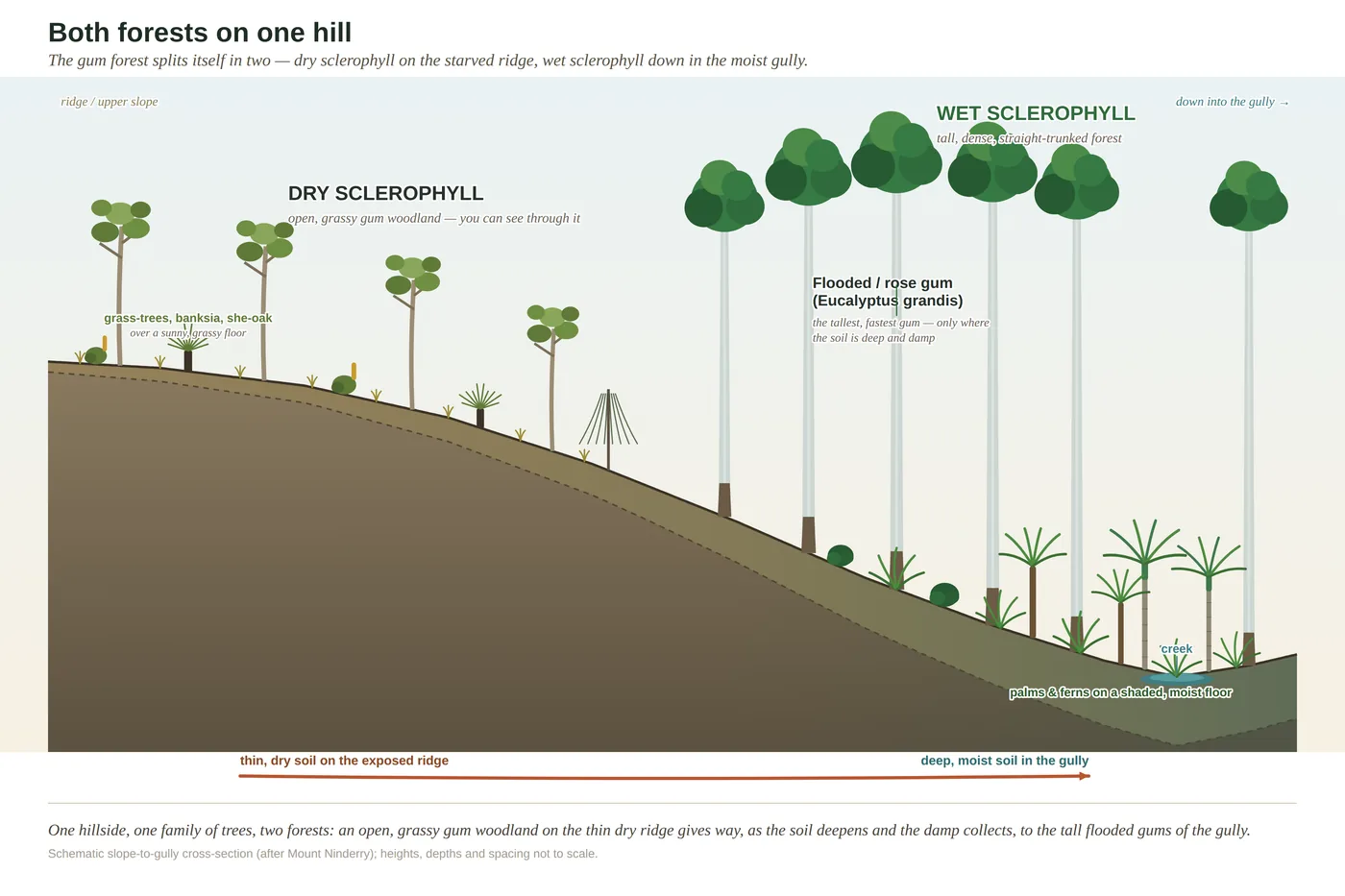
The gum-tree backdrop to everything: hanging grey-green leaves, dappled light, the smell of eucalyptus. Tall, straight trunks over a soft, shrubby floor is wet sclerophyll; low, open, grassy woodland of spotted gum and ironbark is dry. Read the floor as a clock: grassy and flowering means fire has come through recently.
Why it's here
The soil decides it. Give a eucalypt forest more water and nutrient and it grows tall and dense; starve it and it opens into grassy woodland. Running through both, setting the boundaries, is fire, which these trees actively encourage and are armoured to survive.
Who lives here
The koala dozes in a fork, eating almost nothing but gum leaves; the glossy black-cockatoo cracks she-oak cones; gliders and owls den in hollows that take a century of rot to form and an afternoon to fell.
Where to see it
Climb Mount Ninderry, the rhyolite peak behind Yandina, which carries both forests on one hill.
Slope-to-gully cross-section: dry sclerophyll woodland on the ridge, wet sclerophyll forest in the gully
Both forests on one hill: open dry-sclerophyll woodland on the thin-soiled ridge, tall wet-sclerophyll forest down in the moist gully.

Rainforests

The slowest forest of all to grow, and the hardest to get back once it's gone.

Recognise it
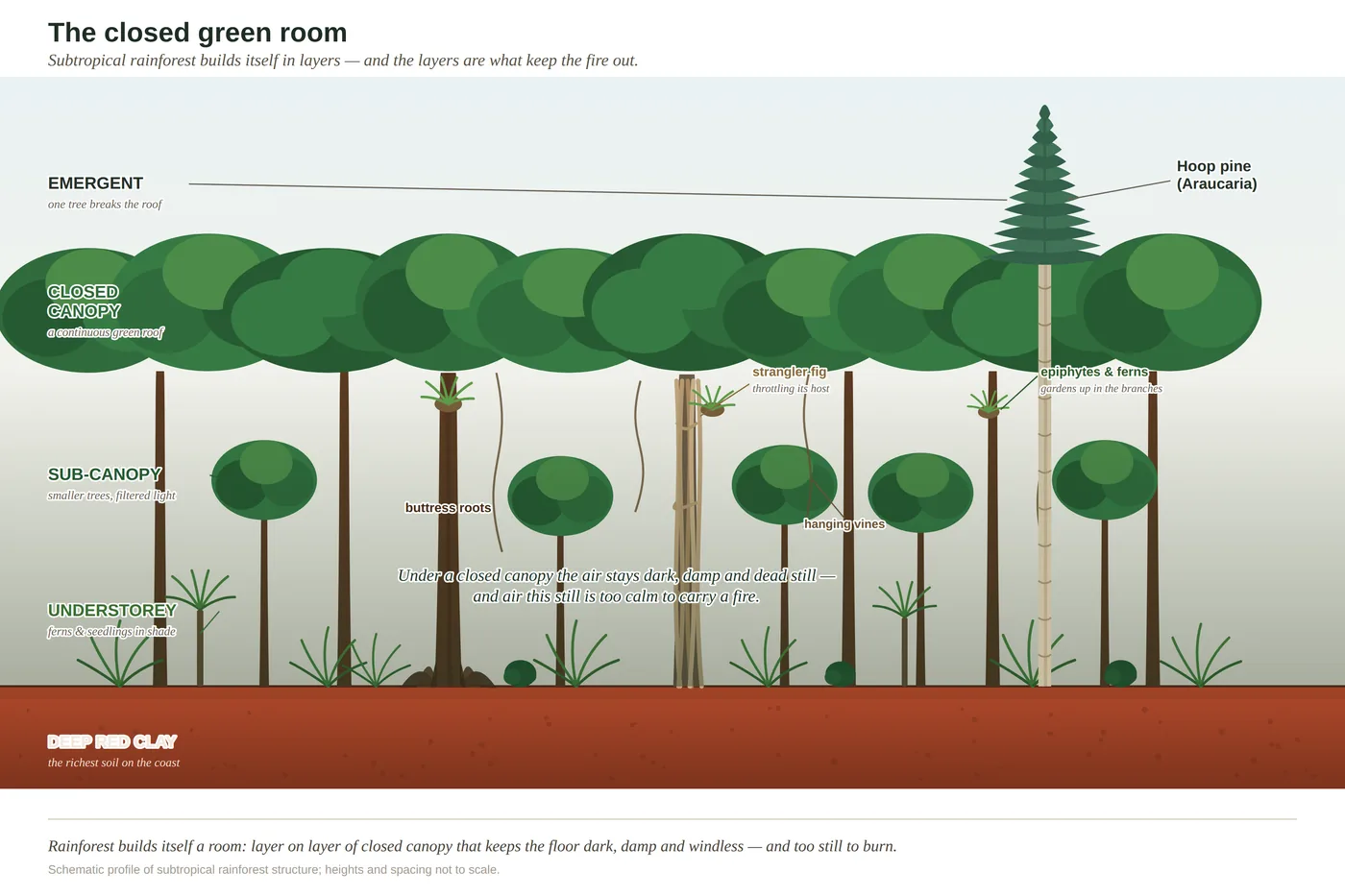
A closed, dim, multi-layered green room on deep red soil, cool and dripping and still. Buttressed trunks, strangling figs, hanging vines and gardens of ferns perched in the branches. A pale, hoop-ringed conifer spearing clear above the canopy marks it as forest far older than the gums around it.
Why it's here
It is the opposite of the wallum: richest soil, deepest shelter, most rain. And the density does the rest: a closed canopy keeps the interior dark, damp and still, and that stillness excludes fire, which is the only thing that lets the forest exist at all.
Who lives here
Fruit-doves, bowerbirds and flying-foxes are the forest's gardeners, moving the seed it depends on. Red-legged pademelons browse the edges; the land mullet, a forearm-long skink, runs out of continent near Maleny.
Where to see it
Step into the remnant big scrub at Mary Cairncross Scenic Reserve, Maleny, on the Blackall Range.
Vertical structure of subtropical rainforest, from red-clay floor to an emergent hoop pine
Rainforest builds itself a room of closed canopy: dark, damp and too still to burn.

Sea country & the reef

The land does not stop at the beach. It changes into something we cannot walk on, and so overlook.

Recognise it
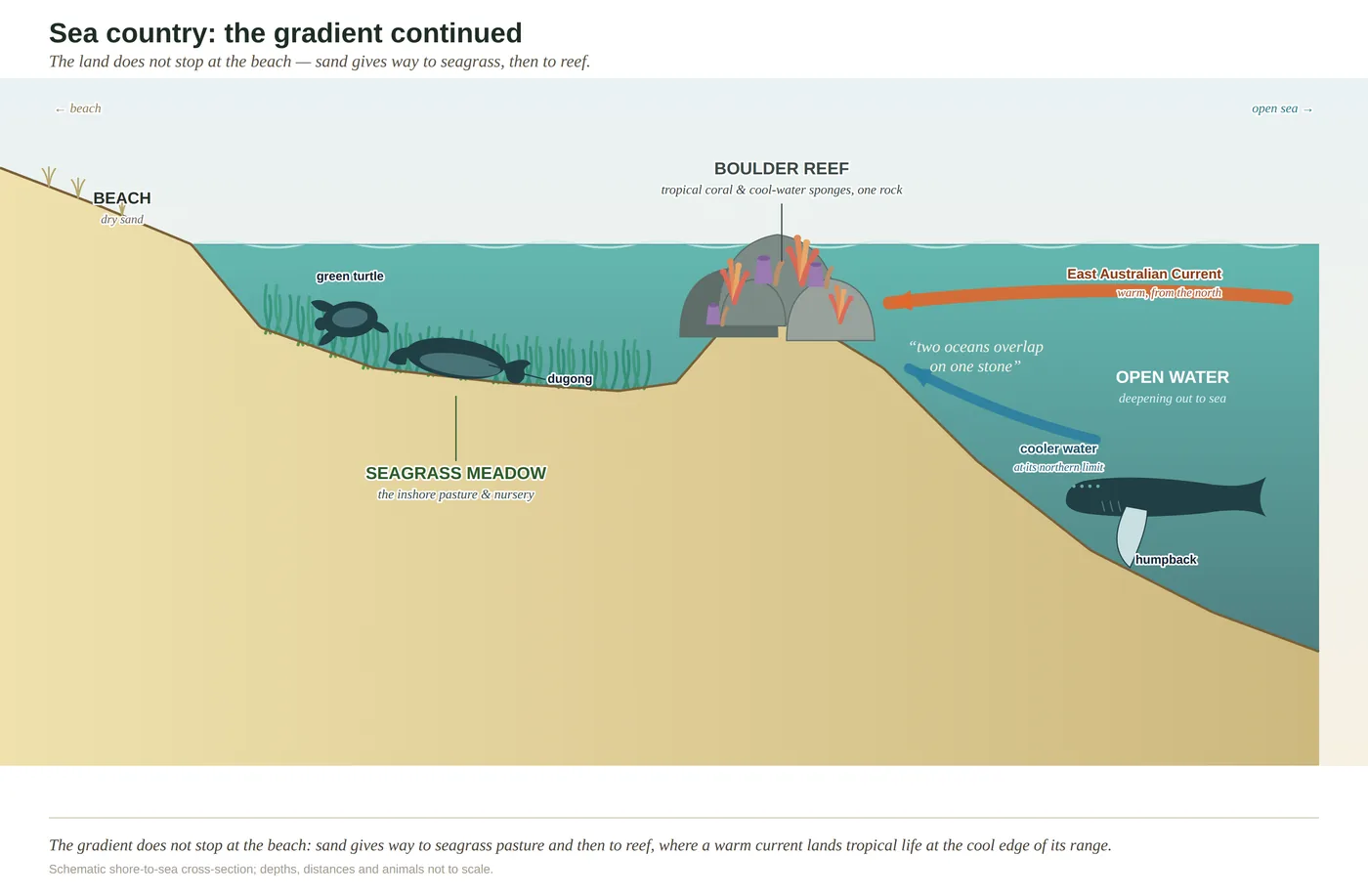
The gradient continued underwater. Pale green shallows over sand are seagrass, the inshore pasture and nursery; hard boulder reefs off the headlands carry a stranger community where tropical coral and cool-water sponges share the same rock.
Why it's here
A current builds the reef. The warm East Australian Current carries tropical larvae south to the very edge of where they can survive, where they meet cooler species at their northern limit, so two oceans overlap on one stone, and a warming sea shows up here early.
Who lives here
Dugong and green turtle graze the seagrass like underwater cattle. Off Wolf Rock the critically endangered grey nurse shark gathers all year, a monster only in its looks. Each winter the humpbacks pass by in their tens of thousands, hunted to a few hundred within living memory and back.
Where to see it
Snorkel the reefs off Point Cartwright and Mooloolaba or around Mudjimba Island, or watch the whales pass in winter.
Shore-to-sea cross-section: beach, seagrass meadow, boulder reef and open water
The gradient continues underwater: sand to seagrass to reef, where a warm current meets the cool.

Now go and read it for yourself

The field guide turns all of this into a method you can carry outside — the five-minute reading, where to go, and what to look for. It's free, and it's the whole point.

Open the field guide About the book